
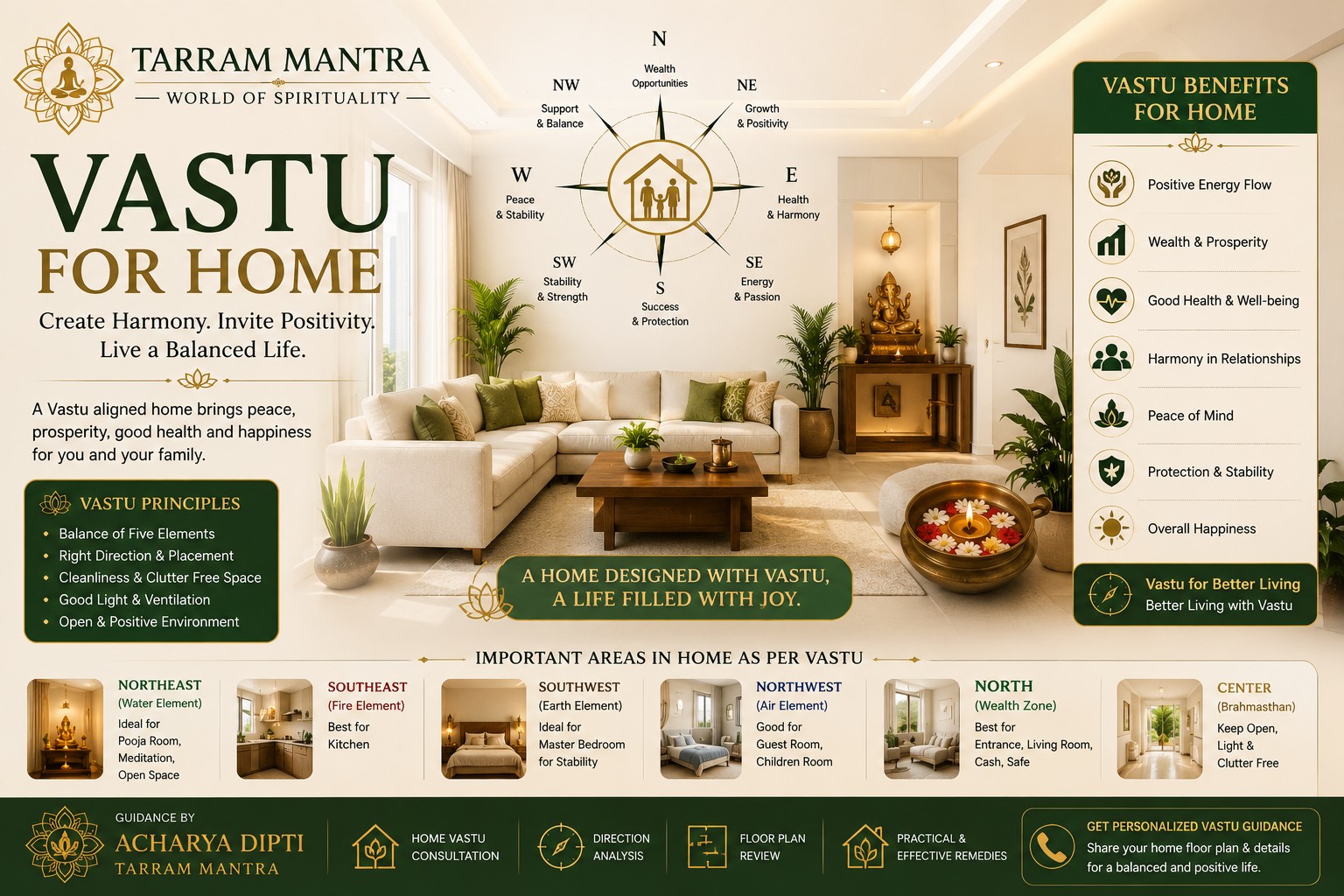
Vastu for Home is a traditional Indian architectural and spatial-planning system that focuses on the relationship between a building, its directions, layout, natural elements, and the people living within it. Traditionally, Vastu Shastra considers the four primary directions, the five elements—Earth, Water, Fire, Air, and Space—and the placement of different rooms and activities within a home. At Tarram Mantra, Acharya Dipti provides Vastu guidance based on traditional principles to help homeowners thoughtfully plan their living spaces.
A Vastu-oriented home generally begins with understanding the direction and orientation of the property. Traditionally, the North, South, East, and West directions are given different significance, while the four diagonal directions—Northeast, Southeast, Southwest, and Northwest—are also considered during planning. The central area of the home, commonly associated with Brahmasthan, is traditionally regarded as an important spatial zone. Proper assessment of the plot, entrance, rooms, open spaces, ventilation, and surrounding environment can help create a more balanced design according to Vastu principles.
The main entrance is an important consideration in traditional Vastu. Its direction, location within that direction, surrounding space, lighting, and overall design may be examined during a Vastu consultation. Similarly, different areas of the home are traditionally associated with different activities—for example, cooking areas with the Fire element, sleeping areas with rest and stability, and prayer or meditation spaces with spiritual reflection. Vastu is therefore not simply about placing objects in particular directions; it can involve considering the overall planning and functionality of the home.
Vastu for a home can also involve natural light, airflow, openness, proportions, cleanliness, and movement within the space. A thoughtfully designed home should be comfortable and practical first, while traditional Vastu principles can be incorporated into the architectural planning wherever appropriate. Modern construction requirements, structural safety, local building regulations, accessibility, and the family's actual needs should always be considered alongside traditional Vastu concepts.
At Tarram Mantra, Vastu guidance from Acharya Dipti can be approached as a personalized assessment rather than a one-size-fits-all formula. Every property has a different shape, orientation, surrounding environment, floor plan, and purpose. A Vastu consultation may therefore consider the plot, entrance, floor plan, room locations, kitchen, bedrooms, bathrooms, staircase, windows, open areas, and other important features before providing suggestions.
Designing a home according to traditional Vastu architecture begins with studying the plot orientation, shape, entrance, surrounding environment, and overall site plan. Before construction begins, the architect or Vastu consultant can evaluate how the proposed building will sit on the property and how different spaces can be organized. Ideally, Vastu considerations should be incorporated during the planning stage rather than attempting major corrections after construction is complete.
The entrance and circulation can then be planned according to the property's orientation and traditional Vastu principles. The entrance is traditionally considered an important transition between the external environment and the home. Adequate natural light, ventilation, a welcoming approach, and an uncluttered entrance can contribute to a pleasant living environment while also supporting the traditional principles of Vastu.
The placement of the kitchen is another important consideration. In traditional Vastu architecture, the Southeast is commonly associated with the Fire element and is therefore traditionally preferred for the kitchen. Northwest is sometimes considered another possible location depending on the property's layout. Practical requirements such as ventilation, exhaust systems, plumbing, electrical safety, appliance placement, and kitchen workflow should also be incorporated into the design.
For bedrooms and living areas, traditional Vastu considers direction, function, stability, and privacy. The Southwest is traditionally associated with stability and is often considered for the master bedroom, while other bedrooms may be planned according to the family's needs and the overall floor plan. Living rooms, study areas, prayer spaces, bathrooms, staircases, balconies, and storage areas can similarly be evaluated according to their intended functions and the available space.
A good Vastu-oriented design should ultimately combine traditional principles with modern architecture. There is no need to sacrifice structural safety, natural ventilation, energy efficiency, accessibility, comfort, or contemporary aesthetics simply to follow a traditional guideline. The best approach is to create a functional and beautiful home first and then thoughtfully integrate applicable Vastu principles into the architectural plan.
According to the traditional Vastu approach presented through Acharya Dipti and Tarram Mantra, homeowners should ideally consider Vastu before purchasing land or beginning construction. Evaluating the plot's direction, shape, slope, road position, surrounding buildings, entrances, and available open space at an early stage can provide more design flexibility. Early planning can also reduce the need for expensive structural changes later.
Acharya Dipti's Vastu guidance can emphasize balance rather than fear. Vastu should not be presented as a reason to become anxious about every small imperfection in a home. Instead, homeowners can first identify the major architectural and functional aspects of the property and then consider practical improvements. Simple measures such as reducing clutter, improving natural light, maintaining ventilation, organizing spaces, and keeping important areas clean can contribute to a more pleasant home environment.
For an existing home, every Vastu recommendation does not necessarily require demolition or major reconstruction. Depending on the property, traditional consultations may explore practical adjustments involving furniture placement, room usage, lighting, colors, organization, plants, symbolic elements, or other non-structural measures. Any structural change should always be evaluated by a qualified architect or structural professional.
Acharya Dipti can also provide personalized Vastu guidance by examining the actual floor plan rather than giving only generic direction-based advice. The property's entrance, kitchen, bedrooms, bathrooms, staircase, Brahmasthan, windows, balconies, extensions, cut corners, and surrounding environment can all be considered together. Where appropriate, Vastu recommendations can be combined with the family's requirements, lifestyle, and future plans.
The central idea of Vastu for Home at Tarram Mantra can therefore be expressed as creating a space that feels organized, harmonious, functional, and comfortable while respecting traditional Vastu principles. Vastu is a traditional architectural and spiritual system, and its effects should not be represented as scientifically guaranteed outcomes. For a meaningful assessment, homeowners can provide their house floor plan, direction/orientation, entrance location, and relevant property details so that Acharya Dipti's traditional Vastu guidance can be more specific to the individual property.
Share your home floor plan and property details for a detailed Vastu consultation with Tarram Mantra.


© Copyright 2025, TARRAM MANTRA All Rights Reserved | Website Designed & Developed by Genwix Pvt. Ltd. www.genwix.com | +91 8595165877
all comments
Vikash Kumar
May 12, 2025Lorem ipsum dolor sit amet, consectetur adipiscing elit. Praesent vehicula mauris ac facilisis congue. Fusce sem enim, rhoncus volutpat condimentum ac, placerat semper ligula. Suspendisse in viverra justo, eu placerat urna. Vestibulum blandit diam suscipit nibh mattis ullamcorper. Nullam a condimentum nulla, ut facilisis enim.
ReplySweta Gupta
June 02, 2025Lorem ipsum dolor sit amet, consectetur adipiscing elit. Praesent vehicula mauris ac facilisis congue. Fusce sem enim, rhoncus volutpat condimentum ac, placerat semper ligula. Suspendisse in viverra justo, eu placerat urna. Vestibulum blandit diam suscipit nibh mattis ullamcorper. Nullam a condimentum nulla, ut facilisis enim.
ReplyRavindra Shrivastava
June 15, 2025Lorem ipsum dolor sit amet, consectetur adipiscing elit. Praesent vehicula mauris ac facilisis congue. Fusce sem enim, rhoncus volutpat condimentum ac, placerat semper ligula. Suspendisse in viverra justo, eu placerat urna. Vestibulum blandit diam suscipit nibh mattis ullamcorper. Nullam a condimentum nulla, ut facilisis enim.
ReplyVikram Shah
June 26, 2025Lorem ipsum dolor sit amet, consectetur adipiscing elit. Praesent vehicula mauris ac facilisis congue. Fusce sem enim, rhoncus volutpat condimentum ac, placerat semper ligula. Suspendisse in viverra justo, eu placerat urna. Vestibulum blandit diam suscipit nibh mattis ullamcorper. Nullam a condimentum nulla, ut facilisis enim.
Reply